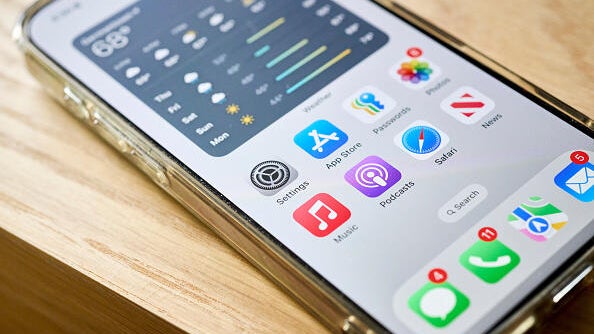
Trump threatens to hit Apple with a 25% tariff on iPhone sales
President Trump said he would impose a steep tariff on Apple unless the company starts manufacturing some iPhones in the U.S.
Watch CBS News

President Trump said he would impose a steep tariff on Apple unless the company starts manufacturing some iPhones in the U.S.

House Republican's budget bill would create $1,000 "Trump accounts" for babies born between January 2025 and January 2029.

Americans preparing to hit the road for Memorial Day are likely to find lowest fuel prices in years, according to Gas Buddy.

The budget bill passed by the House includes a provision to quadruple the state and local tax deduction, a boon for some homeowners.

A GOP tax-and-spending bill the House approved Thursday would slash federal Medicaid reimbursement for states that offer health coverage to immigrants without legal status.

The Treasury Department said it placed its final order for penny blanks this month as the U.S. moves to end production of the 1-cent coin.

A CBS News Confirmed analysis of a dozen skincare influencers' accounts found that many featured ingredients not suitable for kids and were undisclosed brand partnerships or sponsored posts.

The average cost of one pound of ground beef reached a record-high of $5.80 in April, according to numbers from the Bureau of Labor Statistics.

The largest buyers of $TRUMP will be rewarded with a private dinner with President Trump at his golf course in Virginia.

Home equity loan interest rates just hit their lowest point so far in 2025. Here's why owners should take advantage.

Need a way to get out of debt this June? Here are four steps to take that will help you get to that point.

With the price of gold surging, some popular myths are taking precedence. Here's the reality behind three of them.

CBS News is tracking the rising cost of products most impacted by tariffs imposed and soon-to-be-imposed by President Trump, from grocery items to cars and trucks.

These charts track prices consumers pay for groceries and other goods now compared to five years ago.

Allianz survey finds that nearly two-thirds of Americans are more worried about running out of money in retirement than they are about dying.

Americans have big financial goals for what they think they'll need for a comfortable retirement, a new survey finds.

The first weeks of the new Trump administration have sparked stock market jitters and recession fears. Here's advice from top experts.

Federal judge strikes down government regulations requiring most U.S. employers to accommodate workers for abortions.

President Trump has painted a bullseye on diversity, equity and inclusion. But what exactly is DEI, and what has it achieved?

Ample job opportunities, low unemployment and reasonable commute times make this the top U.S. state for job seekers, analysis finds.
President Trump said he would impose a steep tariff on Apple unless the company starts manufacturing some iPhones in the U.S.

As Trump moves to ban foreign students from enrolling at Harvard, at least one university in China says applicants are welcome to come there instead.

The ruling is the latest twist in the saga of the former high-flying minister who earned himself the nickname of "supercop" but instead aided and abetted drug traffickers.

Mothers and relatives of the Venezuelan detainees in CECOT have been communicating about their loved ones in a WhatsApp group.

Peter Wang, honored as a member of the 2025 West Point class, was just 15 when he was killed in the 2018 mass shooting in Parkland, Florida.
President Trump said he would impose a steep tariff on Apple unless the company starts manufacturing some iPhones in the U.S.
A GOP tax-and-spending bill the House approved Thursday would slash federal Medicaid reimbursement for states that offer health coverage to immigrants without legal status.
The average cost of one pound of ground beef reached a record-high of $5.80 in April, according to numbers from the Bureau of Labor Statistics.
A CBS News Confirmed analysis of a dozen skincare influencers' accounts found that many featured ingredients not suitable for kids and were undisclosed brand partnerships or sponsored posts.
Americans preparing to hit the road for Memorial Day are likely to find lowest fuel prices in years, according to Gas Buddy.
President Trump said he would impose a steep tariff on Apple unless the company starts manufacturing some iPhones in the U.S.
Mothers and relatives of the Venezuelan detainees in CECOT have been communicating about their loved ones in a WhatsApp group.
Peter Wang, honored as a member of the 2025 West Point class, was just 15 when he was killed in the 2018 mass shooting in Parkland, Florida.

Data shows the turnaround in military recruitment began under Biden almost two years ago, and enlistments still lag behind pre-pandemic highs.
A GOP tax-and-spending bill the House approved Thursday would slash federal Medicaid reimbursement for states that offer health coverage to immigrants without legal status.
A GOP tax-and-spending bill the House approved Thursday would slash federal Medicaid reimbursement for states that offer health coverage to immigrants without legal status.

Authorities in Hong Kong say COVID-19 levels are the worst in at least a year.
A CBS News Confirmed analysis of a dozen skincare influencers' accounts found that many featured ingredients not suitable for kids and were undisclosed brand partnerships or sponsored posts.

Researchers found GLP-1s may modestly reduce the risk of 14 obesity-related cancers, especially colorectal cancer, when compared to a weight-neutral medication used to treat diabetes.

Alcohol is a known risk factor for cancer, and new research is showing just how much it has impacted death rates in the past three decades.
As Trump moves to ban foreign students from enrolling at Harvard, at least one university in China says applicants are welcome to come there instead.

Ten people accused of robbing Kim Kardashian at gunpoint were given the last word in their trial in Paris before the jury retired to consider its verdict.

The Public Security Ministry said it had never recorded another seizure of the animals, whicgh are a non-native species in Costa Rica.

A massive cargo ship sailed up onto shore just meters from Johan Helberg's house. He slept through the whole commotoion.

Yaron Lischinsky and Sarah Lynn Milgrim, Israeli Embassy staff members, were identified as the victims of a shooting outside the Jewish Museum in Washington, D.C.
Ten people accused of robbing Kim Kardashian at gunpoint were given the last word in their trial in Paris before the jury retired to consider its verdict.

Kermit the Frog is set to speak at Muppets creator Jim Henson's alma mater.

Best known for "Severance," Tramell Tillman takes on the role of Captain Bledsoe in the new "Mission: Impossible" film, earning standout reviews and sharing the screen with Tom Cruise.

Best known for "Severance," actor Tramell Tillman takes on the role of Captain Bledsoe in the new "Mission: Impossible" film.

As a 2025 Hall of Fame inductee, Ronny Chieng shares how growing up across continents, failing the New York bar exam and landing on "The Daily Show" shaped his rise and his voice.
President Trump said he would impose a steep tariff on Apple unless the company starts manufacturing some iPhones in the U.S.

A federal judge in Orlando has ruled that artificial intelligence chatbots do not have free speech in a case centered around a wrongful death lawsuit. A 14-year-old died by suicide last year and his mother says the startup Character.Ai is to blame. Tech journalist Yasmin Khorram breaks it all down.

From labor shortages to environmental impacts, farmers are looking to AI to help revolutionize the agriculture industry. One California startup, Farm-ng, is tapping into the power of AI and robotics to perform a wide range of tasks, including seeding, weeding and harvesting.

Jony Ive, the famed designer behind iconic Apple products, will join OpenAI to create devices with generative artificial intelligence capability.

Fiverr CEO Micha Kaufman recently warned his employees about the impact of artificial intelligence on their jobs. Kaufman joins CBS News with more on his tips to beat the AI curve.

With the 2025 hurricane season starting June 1, NOAA forecasters announced their prediction for how many tropical storms and hurricanes to expect this year.

Slope streaks once believed to be signs of water on Mars might really be signs of rockfall and high winds, a new study says.

Baby KJ Muldoon was born with a rare genetic condition that is often fatal, but doctors used custom CRISPR gene therapy to target the exact mutation in his DNA. His family shares their emotional journey in their first TV interview with CBS News.

Garwin advised several presidents published more than 500 papers and was granted 47 U.S. patents.

The universe is poised to die much faster than previously thought, according to new research by Dutch scientists.
Ten people accused of robbing Kim Kardashian at gunpoint were given the last word in their trial in Paris before the jury retired to consider its verdict.
The Public Security Ministry said it had never recorded another seizure of the animals, whicgh are a non-native species in Costa Rica.

People in Washington, D.C. and beyond are mourning the killings of two Israeli Embassy staffers who were shot outside the Capital Jewish Museum Wednesday. A suspect has been charged with two counts of first-degree murder, murder of foreign officials and other counts. A friend of one of the victims, David Boskey, joins "The Daily Report" to discuss Yaron Lischinsky's life.

Warning: Some may find the details of this report disturbing. The federal sex trafficking trial for Sean "Diddy" Combs is set to resume next Tuesday. On Thursday, Scott Mescudi, known as Kid Cudi, testified in court about his brief relationship with Combs' ex-girlfriend, Cassie Ventura. CBS News national correspondent Jericka Duncan has more details.

A man is in custody after two Israeli Embassy staffers were gunned down as they left the Jewish Museum in Washington, D.C., on Wednesday evening. CBS News national security contributor Sam Vinograd and Department of Justice correspondent Scott MacFarlane have the latest on the investigation. Then, CBS News chief White House correspondent Nancy Cordes joins with reaction from President Trump.

The latest selfie by NASA's Perseverance rover at Mars has captured an unexpected guest: a Martian dust devil.
Slope streaks once believed to be signs of water on Mars might really be signs of rockfall and high winds, a new study says.

Jupiter's stunning auroras are hundreds of times brighter than those seen on Earth, as pictured in new images taken by the James Webb Space Telescope.

May's full flower moon will light up the night sky.

Kosmos 482 was launched by the then-Soviet Union in 1972 as part of a series of missions bound for Venus. But this one never made it out of orbit around Earth, stranded there by a rocket malfunction.

Protests against the Trump administration took place across the U.S. Saturday. The demonstrations were held to mark the 250th anniversary of the start of the Revolutionary War.

A look back at the esteemed personalities who've left us this year, who'd touched us with their innovation, creativity and humanity.

In August 2015, former FBI agent Tom Martens and his daughter Molly Corbett admitted killing her Irish-born husband Jason Corbett, insisting they beat him in self-defense

Hundreds of thousands took to the streets, in Washington, D.C. and other cities across the United States, in opposition to the policies of Donald Trump, in the largest protests since he returned to the presidency.

A look into a grieving husband Jan Cilliers' investigative work after his wife Christy Giles and her friend Hilda Marcela Cabrales died after a night out.

As President Trump's budget bill dominates headlines, Americans are facing the possibility of benefits they depend on being diminished. One of them is the Supplemental Nutrition Assistance Program or SNAP. Elaine Waxman, senior fellow in the tax and income supports division at the Urban Institute, joins "The Daily Report" to discuss.
People in Washington, D.C. and beyond are mourning the killings of two Israeli Embassy staffers who were shot outside the Capital Jewish Museum Wednesday. A suspect has been charged with two counts of first-degree murder, murder of foreign officials and other counts. A friend of one of the victims, David Boskey, joins "The Daily Report" to discuss Yaron Lischinsky's life.

The Department of Homeland Security is barring Harvard University from enrolling foreign students. Homeland Security Secretary Kristi Noem told Fox News that she sent a letter to the privately funded university, saying the students must either transfer or lose their legal status in the U.S. CBS News legal contributor Jessica Levinson breaks it down.

At least two people were killed and eight others were injured after a small plane crashed into a San Diego neighborhood early on Thursday morning. CBS News correspondent Carter Evans reports.

Health and Human Services Secretary Robert F. Kennedy Jr. released his "Make America Healthy Again" report on Thursday. CBS News digital reporter Alexander Tin has more.