
Americans are filing for Social Security at record rates. Here's why.
Spike in early Social Security claims this year points to growing concerns about the health of the Social Security system, experts say.
Watch CBS News

Spike in early Social Security claims this year points to growing concerns about the health of the Social Security system, experts say.

Procter & Gamble plans to cut non-manufacturing jobs as it seeks to compete in what the company calls an "increasingly challenging environment."

Like millions of Americans, Alicia and Chu Gomez are experiencing the waves of an uncertain, see-sawing market.
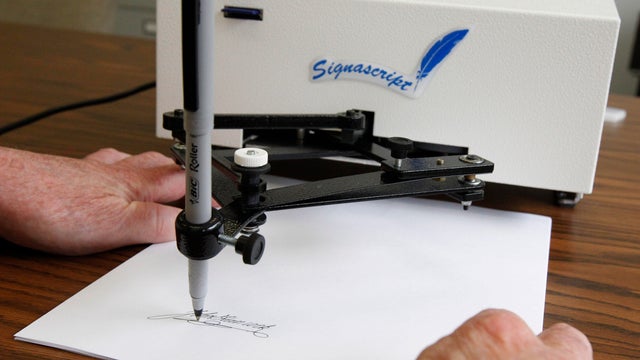
President Trump is putting a political spotlight on autopens, machines that have been used for decades by presidents, writers and more.

The 50% steel and aluminum tariffs could lead to higher prices on everything from cars to home and office supplies.

Roughly a quarter of consumers use "buy now, pay later" loans for ordinary expenses like groceries. That's worrisome, a personal finance expert says.

With two fewer aircraft in its fleet, Alaska Airlines says it is trimming its summer flight schedule.

Tariffs affect almost all of the 500-plus products that Munchkin sells, the vast majority of which are made in China.

President Trump's sweeping tariff plan would cut deficits by $2.8 trillion over 10 years while shrinking the economy, the nonpartisan Congressional Budget Office said.

Struggling with medical bills? Here's how to qualify for forgiveness (and what to do if you don't meet the criteria).

Doing your research and applying for private student loans now can help you pay for the fall 2025 college semester.

A $10,000 18-month CD could earn savers a major return if opened now, but they'll need to be aggressive to get it.

CBS News is tracking the rising cost of products most impacted by tariffs imposed and soon-to-be-imposed by President Trump, from grocery items to cars and trucks.

These charts track prices consumers pay for groceries and other goods now compared to five years ago.

Allianz survey finds that nearly two-thirds of Americans are more worried about running out of money in retirement than they are about dying.

Americans have big financial goals for what they think they'll need for a comfortable retirement, a new survey finds.

The first weeks of the new Trump administration have sparked stock market jitters and recession fears. Here's advice from top experts.

Federal judge strikes down government regulations requiring most U.S. employers to accommodate workers for abortions.

President Trump has painted a bullseye on diversity, equity and inclusion. But what exactly is DEI, and what has it achieved?

Ample job opportunities, low unemployment and reasonable commute times make this the top U.S. state for job seekers, analysis finds.

The video and images show Travis Decker in the days leading up to a visitation with his daughters, police say.

The Supreme Court on Thursday blocked the Mexican government's lawsuit against major U.S. gun manufacturers, delivering a win for the firearms industry.

The Supreme Court on Thursday revived a lawsuit from an Ohio woman who claimed she was the victim of reverse discrimination.

President Trump spoke to Chinese President Xi Jinping on Thursday amid an ongoing dispute over a temporary deal to ease the escalation of tariffs.

Newly elected German Chancellor Friedrich Merz is meeting with President Trump at the White House on Thursday.
President Trump spoke to Chinese President Xi Jinping on Thursday amid an ongoing dispute over a temporary deal to ease the escalation of tariffs.
Spike in early Social Security claims this year points to growing concerns about the health of the Social Security system, experts say.
Procter & Gamble plans to cut non-manufacturing jobs as it seeks to compete in what the company calls an "increasingly challenging environment."

A private lunar lander from Tokyo-based company ispace is closing in on the moon, aiming for a touchdown in the unexplored far north with a mini rover.
Like millions of Americans, Alicia and Chu Gomez are experiencing the waves of an uncertain, see-sawing market.

President Trump signed a proclamation late Wednesday barring travelers and immigrants from a dozen countries and restricting the entry of nationals from seven other nations.
The Supreme Court on Thursday blocked the Mexican government's lawsuit against major U.S. gun manufacturers, delivering a win for the firearms industry.
The Supreme Court on Thursday revived a lawsuit from an Ohio woman who claimed she was the victim of reverse discrimination.
President Trump spoke to Chinese President Xi Jinping on Thursday amid an ongoing dispute over a temporary deal to ease the escalation of tariffs.

Trump's move to bar U.S. entry for nationals from 12 countries has people even in an unlisted nation wondering if "Americans just don't like us anymore."

The National Cancer Institute could see nearly 40% of its funding slashed under President Trump's 2026 budget proposal. Former Cancer Moonshot official Dr. Kamal Menghrajani joins "CBS Mornings Plus" to break down what's at stake.

The Trump administration wants to shutter the CDC's National Asthma Control Program, which provides millions in funding to state-administered initiatives aimed at fighting the disease.

HHS Secretary Robert F. Kennedy Jr. asked the FDA "to review the latest data on mifepristone," but experts say concerns about the abortion pill's safety are misguided.

The beef, which may be contaminated with E. coli, was distributed to Whole Foods Market retail locations across the U.S.

The tomatoes, recalled for potential salmonella contamination, were shipped to Georgia, North Carolina and South Carolina.

Oscar Pistorius competes in his first race since murdering his girlfriend Reeva Steenkamp at his home in South Africa 12 years ago.
Trump's move to bar U.S. entry for nationals from 12 countries has people even in an unlisted nation wondering if "Americans just don't like us anymore."
Newly elected German Chancellor Friedrich Merz is meeting with President Trump at the White House on Thursday.

German police say severe storms in southern Germany forced a Ryanair flight to make an emergency landing after violent turbulence injured nine people on board.

At a Los Tucanes de Tijuana performance, nearly a third of their songs were "narcocorridos" glamorizing drug traffickers, officials said.

Nintendo of America President Doug Bowser joins "CBS Mornings Plus" as fans line up across the country to get their hands on the company's first new console since the original Switch debuted in 2017.

The trailer for the highly-anticipated sequel, "Wicked: For Good," has been released. In the film, Elphaba and Glinda team up to challenge the Wizard of Oz.
At a Los Tucanes de Tijuana performance, nearly a third of their songs were "narcocorridos" glamorizing drug traffickers, officials said.

U.K. pop singer Jessie J announced her breast cancer diagnosis in a video on Instagram, saying she learned of it before her new single "No Secrets" was released.

Tony Award winner Cynthia Erivo tells "CBS Mornings" how Elphaba from "Wicked' has matured ahead of Erivo hosting the 78th Annual Tony Awards on Sunday.

Meta has signed a 20-year agreement to buy nuclear power from Constellation Energy, joining the growing list of tech giants turning to nuclear energy to meet the demands of artificial intelligence. Bloomberg News tech reporter Riley Griffin has more.

A Blue Origin sub-orbital spacecraft successfully rocketed to an altitude more than 60 miles above the Earth Saturday with a crew of six. After separating from its booster, the capsule touched down in the West Texas desert about 10 minutes after liftoff.

From labor shortages to environmental impacts, farmers are looking to AI to help revolutionize the agriculture industry. One California startup, Farm-ng, is tapping into the power of AI and robotics to perform a wide range of tasks, including seeding, weeding and harvesting.

Some colleges are turning to classic tactics to try to keep A.I. out of the classroom. Sales of lined composition test books — known as "blue books" — which students used to use to handwrite essays and answers on exams, are on the rise, the Wall Street Journal reported. Here's how schools are trying to tackle the exploding use of A.I.

Google and the Justice Department are set to begin closing arguments in the historic antitrust case that started nine months ago when a federal judge ruled Google has a monopoly over the search engine market. CBS News' Jake Rosen has the latest updates.
A private lunar lander from Tokyo-based company ispace is closing in on the moon, aiming for a touchdown in the unexplored far north with a mini rover.

Iran's foreign minister says his country will not accept any nuclear deal with the U.S. that completely bans uranium enrichment. Anna Erickson, professor of nuclear and radiological engineering at Georgia Institute of Technology, joins "The Daily Report" to discuss.

Two Chinese researchers were charged with trying to smuggle strains of a fungus called Fusarium graminearum into the U.S.

The National Science Foundation (NSF) has terminated thousands of research grants, following President Trump's executive order. Todd Wolfson, President of the American Association of University Professors, joins "CBS Mornings Plus" with more details.

It had not been thought possible that such tiny, weak stars could provide the conditions needed to form and host huge planets.
The video and images show Travis Decker in the days leading up to a visitation with his daughters, police say.

A former graphic designer for Sean "Diddy" Combs testified at his sex trafficking trial, alleging that the music mogul once held her over a balcony at Cassi Ventura's apartment. CBS News' Katrina Kaufman reports.
The Chelan County Sheriff's Office released video of Travis Decker, the man suspected of killing his three daughters in Washington state. The video shows Decker before the girls were reported missing and then found dead near a campground on Monday.

Mohamed Soliman, the man accused of attacking protesters in Boulder, Colorado, with Molotov cocktails, will face a judge Thursday on dozens of charges. His family remains in ICE custody. CBS News' Omar Villafranca reports.
At a Los Tucanes de Tijuana performance, nearly a third of their songs were "narcocorridos" glamorizing drug traffickers, officials said.
A private lunar lander from Tokyo-based company ispace is closing in on the moon, aiming for a touchdown in the unexplored far north with a mini rover.
It had not been thought possible that such tiny, weak stars could provide the conditions needed to form and host huge planets.

Scientists have unlocked one of the solar system's many secrets from an unexpected source: a planetarium show.

The northern lights — also called aurora borealis — could be visible in Alaska, Washington, Montana, North Dakota, Minnesota, Michigan, Maine, northern parts of Idaho, Wyoming, Iowa, New York, Vermont and New Hampshire.

President Trump withdrew his nomination for Jaren Isaacman, an Elon Musk ally, to lead NASA. Mr. Trump said he would soon announce a new nominee. CBS News' Weijia Jiang has the latest.

Live performances are in full swing this summer. Scroll through our concert gallery, featuring pictures by CBS News photojournalist Jake Barlow and photographers Ed Spinelli and Kirstine Walton.

A look back at the esteemed personalities who've left us this year, who'd touched us with their innovation, creativity and humanity.

Protests against the Trump administration took place across the U.S. Saturday. The demonstrations were held to mark the 250th anniversary of the start of the Revolutionary War.

A suspect was taken into custody after an attack on Pearl Street Mall in Boulder on June 1 in which there were 15 people and a dog who were victims. The suspect threw Molotov cocktails that burned some of the victims, who were part of a march for Israeli hostages.

In August 2015, former FBI agent Tom Martens and his daughter Molly Corbett admitted killing her Irish-born husband Jason Corbett, insisting they beat him in self-defense

Dilly Dally the sea turtle had to have one of her flippers amputated after being bitten by an ocean predator. Now, the adolescent loggerhead has been released back into the sea off Florida's coast after months of rehabilitation.
Nintendo of America President Doug Bowser joins "CBS Mornings Plus" as fans line up across the country to get their hands on the company's first new console since the original Switch debuted in 2017.
The National Cancer Institute could see nearly 40% of its funding slashed under President Trump's 2026 budget proposal. Former Cancer Moonshot official Dr. Kamal Menghrajani joins "CBS Mornings Plus" to break down what's at stake.

The Supreme Court is issuing several rulings before the end of its term. The justices ruled unanimously in favor of an Ohio woman who sought legal action for reverse discrimination. The court also blocked a Mexican government lawsuit against major U.S. gun manufacturers. Major Garrett anchored the CBS News special report.

Brianne Howey and Antonia Gentry join "CBS Mornings" and "CBS Mornings Plus" to discuss what's ahead for "Ginny & Georgia" as the comedy-drama returns with high stakes and emotional turns.